Folder Challenge (Part #2)
PythonHardalgorithmsdata_structureslogic
Instructions
This is a sequel to part #1, with the same setup, but a different goal.
A folder system on a computer might look something like the picture below:
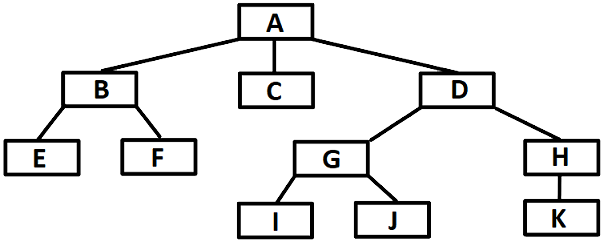
In this challenge, folder systems will be represented by dictionaries where the keys are folders X and the value at X is the list of subfolders of X.
For example, the picture above becomes the dictionary:
{
  "A": ["B", "C", "D"],
  "B": ["E", "F"],
  "D": ["G", "H"],
  "G": ["I", "J"],
  "H": ["K"]
}
The inputs for this challenge will be:
- A dictionary representing a folder system.
- Two folders
XandY.
Write a function that finds the "smallest" folder containing both X and Y (in the illustration, this is the lowest folder for which you can travel down to both X and Y; or, if you view the system as a "family tree", this is the last common ancestor).
Examples
last_ancestor({
  "A": ["B", "C", "D"],
  "B": ["E", "F"],
  "D": ["G", "H"],
  "G": ["I", "J"],
  "H": ["K"]
}, "B", "C") ➞ "A"

last_ancestor({
  "A": ["B", "C", "D"],
  "B": ["E", "F"],
  "D": ["G", "H"],
  "G": ["I", "J"],
  "H": ["K"]
}, "I", "J") ➞ "G"

last_ancestor({
  "A": ["B", "C", "D"],
  "B": ["E", "F"],
  "D": ["G", "H"],
  "G": ["I", "J"],
  "H": ["K"]
}, "I", "K") ➞ "D"

last_ancestor({
  "A": ["B", "C", "D"],
  "B": ["E", "F"],
  "D": ["G", "H"],
  "G": ["I", "J"],
  "H": ["K"]
}, "D", "I") ➞ "D"

last_ancestor({
  "A": ["B", "C", "D"],
  "B": ["E", "F"],
  "D": ["G", "H"],
  "G": ["I", "J"],
  "H": ["K"]
}, "G", "G") ➞ "G"
Notes
- All the examples above use the folder system in the illustration, but the tests will use other folder systems as well.
- For the purposes of this challenge, any folder is inside itself, as in the last two examples.
python3
Loading editor…
⌘ ↵ to run
Walks through the solution with reasoning and edge cases.