Error Detection Part 2: The Hamming Coder
PythonHardlogicbit_operations
Instructions
This challenge is a continuation of Error Detection Part 1: The Hamming Checker . To recap:
- Every redundant bit in a Hamming block informs about the parity of the numbers of
1s inside its region: a0indicates an even number of1s, and a1indicates an odd number of1s. - Redundant bits are always placed in powers of two: index
1,2,4, etc., or binary1,10,100, etc. - All indices inside a region are related to the index of the redundant bit for that region: for the redundant bit in position
0100(decimal4), the indices in its region are0101,0110,0111,1100,1101,1110and1111. Specifically, all these have a1for the third-to-last digit. This pattern applies to all regions: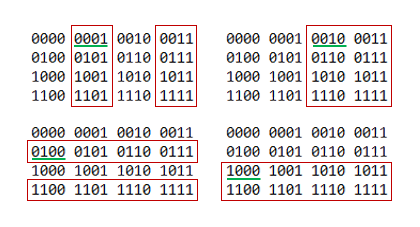
- A block with m bits needs n redundant bits, where 2^n = m.
For this challenge, your task is to write a function that takes a Hamming block and fills in all the redundant bits with the appropriate value. The redundant bits are already in place, but they are all 0s.
This time, the bit indexed 0 will be put to use. This bit will encode information about the whole block, taking on the value (0 or 1) that makes the total number of 1s even. Using this extra bit allows the receiver to detect if there have been two errors, albeit not their positions.
Your code should work for blocks of different sizes (sizes will always be powers of two).
Examples
hamming_coder("0000010100011000") ➞ "0100110100011000"

hamming_coder("0000000001010000") ➞ "1010000001010000"

hamming_coder("00010111010110000111001110001010") ➞ "00110111010110000111001110001010"

hamming_coder("00000110001001000111010100100101") ➞ "10101110101001000111010100100101"
Notes
- Redundant bits always have powers of two as their indices.
- Each region divides the block into two. Some regions divide the block vertically, with columns doubling in width; some others divide the block horizontally, with rows doubling in height. The redundant bits always sit at the top left corner of each region. Here's an example of how a block size 32 would be partitioned.
python3
Loading editor…
⌘ ↵ to run
Walks through the solution with reasoning and edge cases.