Centered Polygonal Number
PythonHardmathnumbers
Instructions
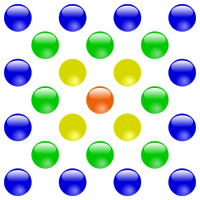
The centered polygonal numbers are a family of sequences of 2-dimensional figurate numbers, each formed by a central dot, surrounded by polygonal layers with a constant number of sides. Each side of a polygonal layer contains one dot more than a side in the previous layer.
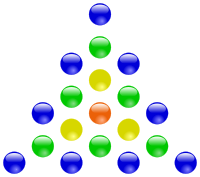 |
| 
- | -
Centered triangular numbers | Centered square numbers
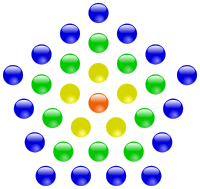 |
| 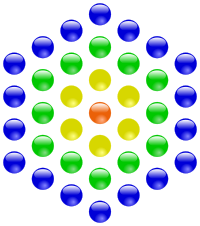 Centered pentagonal numbers | Centered hexagonal numbers
In the following table are listed the first 12 terms of the sequences of centered k-polygonal numbers, with k from 3 to 22:
| k | Name | 0 | 1 | 2 | 3 | 4 | 5 | 6 | 7 | 8 | 9 | 10 | 11 |
|---|---|---|---|---|---|---|---|---|---|---|---|---|---|
| 3 | Triangular | 1 | 4 | 10 | 19 | 31 | 46 | 64 | 85 | 109 | 136 | 166 | 199 |
| 4 | Square | 1 | 5 | 13 | 25 | 41 | 61 | 85 | 113 | 145 | 181 | 221 | 265 |
| 5 | Pentagonal | 1 | 6 | 16 | 31 | 51 | 76 | 106 | 141 | 181 | 226 | 276 | 331 |
| 6 | Hexagonal | 1 | 7 | 19 | 37 | 61 | 91 | 127 | 169 | 217 | 271 | 331 | 397 |
| 7 | Heptagonal | 1 | 8 | 22 | 43 | 71 | 106 | 148 | 197 | 253 | 316 | 386 | 463 |
| 8 | Octagonal | 1 | 9 | 25 | 49 | 81 | 121 | 169 | 225 | 289 | 361 | 441 | 529 |
| 9 | Nonagonal | 1 | 10 | 28 | 55 | 91 | 136 | 190 | 253 | 325 | 406 | 496 | 595 |
| 10 | Decagonal | 1 | 11 | 31 | 61 | 101 | 151 | 211 | 281 | 361 | 451 | 551 | 661 |
| 11 | Hendecagonal | 1 | 12 | 34 | 67 | 111 | 166 | 232 | 309 | 397 | 496 | 606 | 727 |
| 12 | Dodecagonal | 1 | 13 | 37 | 73 | 121 | 181 | 253 | 337 | 433 | 541 | 661 | 793 |
| 13 | Tridecagonal | 1 | 14 | 40 | 79 | 131 | 196 | 274 | 365 | 469 | 586 | 716 | 859 |
| 14 | Tetradecagonal | 1 | 15 | 43 | 85 | 141 | 211 | 295 | 393 | 505 | 631 | 771 | 925 |
| 15 | Pentadecagonal | 1 | 16 | 46 | 91 | 151 | 226 | 316 | 421 | 541 | 676 | 826 | 991 |
| 16 | Hexadecagonal | 1 | 17 | 49 | 97 | 161 | 241 | 337 | 449 | 577 | 721 | 881 | 1057 |
| 17 | Heptadecagonal | 1 | 18 | 52 | 103 | 171 | 256 | 358 | 477 | 613 | 766 | 936 | 1123 |
| 18 | Octadecagonal | 1 | 19 | 55 | 109 | 181 | 271 | 379 | 505 | 649 | 811 | 991 | 1189 |
| 19 | Enneadecagonal | 1 | 20 | 58 | 115 | 191 | 286 | 400 | 533 | 685 | 856 | 1046 | 1255 |
| 20 | Icosagonal | 1 | 21 | 61 | 121 | 201 | 301 | 421 | 561 | 721 | 901 | 1101 | 1321 |
| 21 | Icosihenagonal | 1 | 22 | 64 | 127 | 211 | 316 | 442 | 589 | 757 | 946 | 1156 | 1387 |
| 22 | Icosidigonal | 1 | 23 | 67 | 133 | 221 | 331 | 463 | 617 | 793 | 991 | 1211 | 1453 |
As you can see:
- 6 is the 1st pentagonal number.
- 16 is the 2nd pentagonal number and the 1st pentadecagonal number.
- 19 is the 3rd triangular number, the 2nd hexagonal number and the 1st octadecagonal number.
Write a function that takes an integer n as argument and returns its classification as polygonal number:
- return
"0th of all"ifnis 1, since it is the 0th term of every centered polygonal number sequence. - return a list whose generic element is a string formatted as
"{i}th {k}-gonal number"ifnis the i-th k-gonal number, in k-ascending order. - return
Falseifnis not a k-gonal number for any k > 2.
Examples
is_polygonal(3) ➞ False

is_polygonal(4) ➞ ["1st 3-gonal number"]

is_polygonal(16) ➞ ["2nd 5-gonal number", "1st 15-gonal number"]
Notes
N/A
python3
Loading editor…
⌘ ↵ to run
Walks through the solution with reasoning and edge cases.