Sudoku Parser
PythonHardclassesstringsgamesarrays
Instructions
Create a class Sudoku that takes a string as an argument. The string will contain the numbers of a regular 9x9 sudoku board left to right and top to bottom, with zeros filling up the empty cells.
Attributes
An instance of the class Sudoku will have one attribute:
board: a list representing the board, with sublits for each row, with the numbers as integers. Empty cell represented with0.
Methods
An instance of the class Sudoku wil have three methods:
get_row(n): will return the row in positionn.get_col(n): will return the column in positionn.get_sqr([n, m]): will return the square in positionnif only one argument is given, and the square to which the cell in position(n, m)belongs to if two arguments are given.
Example
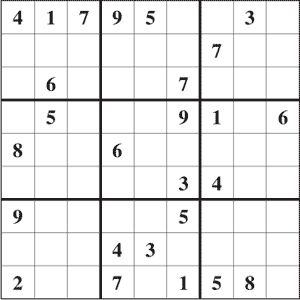
game = Sudoku("417950030000000700060007000050009106800600000000003400900005000000430000200701580")

game.board ➞ [
  [4, 1, 7, 9, 5, 0, 0, 3, 0],
  [0, 0, 0, 0, 0, 0, 7, 0, 0],
  [0, 6, 0, 0, 0, 7, 0, 0, 0],
  [0, 5, 0, 0, 0, 9, 1, 0, 6],
  [8, 0, 0, 6, 0, 0, 0, 0, 0],
  [0, 0, 0, 0, 0, 3, 4, 0, 0],
  [9, 0, 0, 0, 0, 5, 0, 0, 0],
  [0, 0, 0, 4, 3, 0, 0, 0, 0],
  [2, 0, 0, 7, 0, 1, 5, 8, 0]
]

game.get_row(0) ➞ [4, 1, 7, 9, 5, 0, 0, 3, 0]
game.get_col(8) ➞ [0, 0, 0, 6, 0, 0, 0, 0, 0]
game.get_sqr(1) ➞ [9, 5, 0, 0, 0, 0, 0, 0, 7]
game.get_sqr(1, 8) ➞ [0, 3, 0, 7, 0, 0, 0, 0, 0]
game.get_sqr(8, 3) ➞ [0, 0, 5, 4, 3, 0, 7, 0, 1]
Notes
- All positions are indexed to 0.
- All orders are assigned left to right and top to bottom.
python3
Loading editor…
⌘ ↵ to run
Walks through the solution with reasoning and edge cases.